|
| Title: | Energy-efficient formation control of multi-vessel systems under environmental disturbances | | | Authors: | X. Xiong, R.R. Negenborn, Y. Pang |
| | Journal: | Ocean Engineering | | |
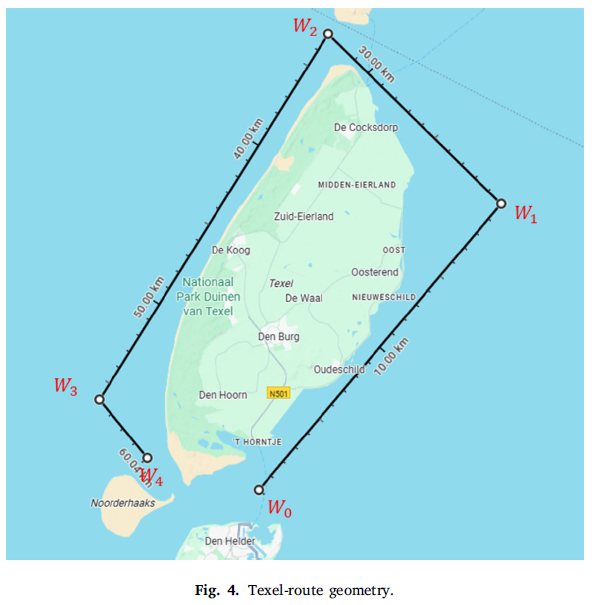
| | Abstract: | Energy-aware formation operation of multi-vessel systems can reduce propulsive demand by exploiting ship-to-ship interaction, yet maintaining persistent benefits on realistic routes remains challenging. In practice, wind and current loads and waypoint turns disturb speed coordination and interaction-favorable spacing, making the energy advantage become temporary unless the formation can rapidly re-establish its geometry after turns. Wave effects are represented in the energy accounting via a time varying added-resistance index, while residual wave induced fluctuations are treated as part of a lumped unmodeled disturbance in the maneuvering dynamics. This paper studies three vessels formation control on a realistic coastal waypoint route around an island in The Netherlands under combined environmental disturbances and compares a centralized model predictive control (CMPC) architecture with a leader-follower MPC (LF-MPC) architecture. The CMPC, previously validated on straight-line scenarios, is shown to exhibit a recurring post-turn spacing limitation: follower spacings may converge slowly and can settle with a persistent offset, preventing the formation from remaining in interaction-beneficial regions. To mitigate this effect, LF-MPC separates responsibilities, with the leader focusing on route tracking under disturbance compensation and the followers regulating leader-relative spacing variables in a leader-aligned frame. Using tracking, spacing, speed-coordination, control-activity, and interaction-aware energy metrics, complemented by a turn-window analysis, simulations show that LF-MPC preserves leader path-following accuracy while achieving faster post-turn spacing recovery, thereby maintaining beneficial spacings for a larger fraction of the mission and improving the interaction-aware energy outcome. |
| | Reference: | Energy-efficient formation control of multi-vessel systems under environmental disturbances. X. Xiong, R.R. Negenborn, Y. Pang. Ocean Engineering, vol. 363, no. 126594, August 2026. Open access. | | | Download: | Open access |
|
|