|
| MSc thesis topic |
| |
In a conventional control setting, there is a single controller that controls the
system. This controller collects information from measurements of the
system to determine which inputs to select. However, many real world systems,
like for example traffic, water, and power networks are large in scale, and
therefore hard to control by a single controller, since this
controller would have to gather information from all sensors, and process
this directly to provide inputs to all actuators. This is not only
hard due to technical issues like communication delays and
computational requirements, but also due to practical issues like
unavailability of information from one part of the network to another and
restricted control access. For this type of systems a control approach with
multiple controllers
has to be employed.
In such a multi-controller setting several controllers, each with only limited
information
gathering and processing skills and moreover limited action
capabilities, control the subsystems (e.g., subnetworks) of which the
overall network is composed. Since the subsystems they control are
part of an overall network, inputs selected by one controller influence
inputs selected by other controllers. The challenge for this type of control
is therefore to make the controllers cooperate, that is, work together, such that
the overall network performance is as desired. In our case, we investigate how
such a scheme works when the controllers employ model predictive control, see
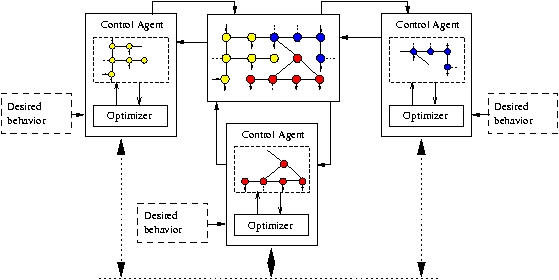
Fig. 1.
|
Fig. 1: Illustration of multi-controller model predictive control. Control
agents control parts of the overall network. Each of the controllers has a model
of the
subnetwork it controls. Controllers communicate with neighboring
controllers.
Through an optimization procedure they
decide which inputs to implement on their subsystems.
|
Assignment:
In this project you consider a control setting in which a power or traffic
network is divided into subnetworks, each controlled by a controller using model
predictive control. You look at how the network can be split up into smaller
parts and how the controllers have to cooperate with one another to obtain good
overall system behavior (for example by exchanging predictions about what each
controller expects to do in the future).
More information:
If you are interested in selecting this project as your MSc project,
please come along or send me an email for more information.
|
|
|